
The emotional power of speaking your mother tongue
Snjezana Markus
3 min read


When I moved to Ireland, I spent the first few weeks getting used to driving on the “wrong” side of the road. One day, my husband and I found ourselves in a stressful situation at a roundabout. Our reaction was what stood out, not the situation itself.
The explanation was in English.
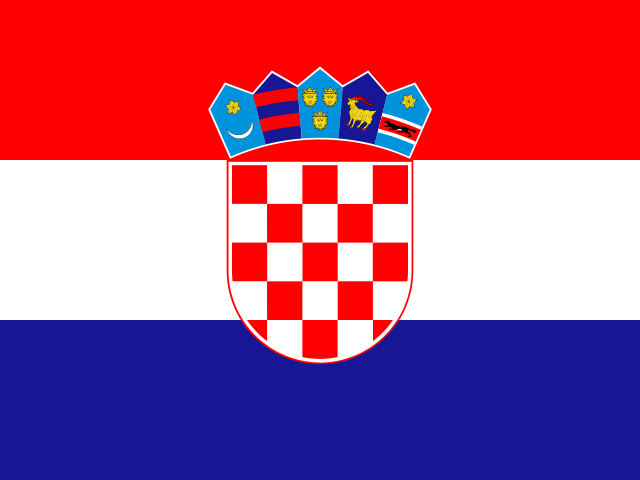
The swearing was in Croatian.
That moment stayed with me and made something very clear:
👉 when emotions are high, we return to our mother tongue.
Of course, for people who grew up bilingually or multilingually themselves, that emotional connection can naturally exist across more than one native language and the same principle applies throughout this discussion.
The language of emotion ❤️
Our first language is not just something we learn. It is something we grow into.
It is acquired during early childhood, at the same time as we are forming our first relationships, memories and emotional responses. That’s why it is often called the “language of the heart” or “language of the soul”.
Research supports this. Studies in psycholinguistics show that the native language is more strongly connected to the brain’s emotional processing systems, including the amygdala and limbic system. Words in a mother tongue tend to feel more intense, more immediate and more personal than those in a later learned language.
This is why:
“I love you” feels different in your native language
anger comes out more naturally in it
emotional memories are often tied to it
It is not just about vocabulary. It is about lived experience, where words become directly connected to emotions.


What children learn from this
I have often seen parents who don’t pass on their native language switch to it only in moments of frustration:
“Get in the car!” 🚗
“Calm down now!” 😠
In those moments, the mother tongue appears as the language of urgency, anger or control.
What your children will learn from that won’t be the language itself, but the emotional context attached to it.
If a language is only used when something is wrong, it becomes associated with negative emotions. If it’s used for everyday interaction, affection and connection, it carries a very different meaning.
Beyond usefulness
When parents decide they won’t pass on their mother tongue, the reasoning is often practical.
“Everyone speaks English.”
“It will be easier for the child.”
“It’s more useful.”
From a purely utilitarian perspective, this does make sense, but language isn’t only a tool.
Your mother tongue carries your personal history, your cultural background and your way of expressing emotions. It shapes how you tell stories, how you comfort, how you react, how you connect.
Choosing not to pass your language isn’t just a language decision. It is, in part, a decision about what parts of yourself you bring into the relationship with your child.
That said, every family situation is different and there is no single approach that works for everyone.


🫶 The full version of yourself
Every parent has a language in which they feel most natural. The one you use for affection, comfort, humour, frustration and honesty.
For me, that language is Croatian. There is no other language in which I could say “I love you” to my child in the same way. It’s the language of cuddling, of small everyday moments, but also of disappointment, boundaries and everything in between.
And that matters more than most parents realise.
Children don’t just learn words. They learn who you are through the way you speak to them.
When you use your mother tongue, you are giving your child access to a fuller, more authentic version of yourself. You’re not just teaching a language.


Looking ahead
Try to imagine your child ten years from now. You’re having a serious conversation. Maybe it’s about friendships, identity, relationships or something difficult they are going through.
Which language do you picture using? Which language feels natural for that moment?
That answer often tells you everything you need to know. The language you choose shapes how deeply you connect, not only how you communicate with your child.
Final thoughts ✨
Passing on your mother tongue is about connection and identity, not only about raising a bilingual child.
It is about allowing your child to experience your language in the full range of human emotions, not just in the moments of correction or urgency.
At the end of the day, when you speak to your child in your mother tongue, you aren’t just passing on a language.
You are passing on your whole story.
Contact
Newsletter
© 2026. All rights reserved.
MULTILINGUAL MARVELS
... because multilingualism is a lifelong gift.