
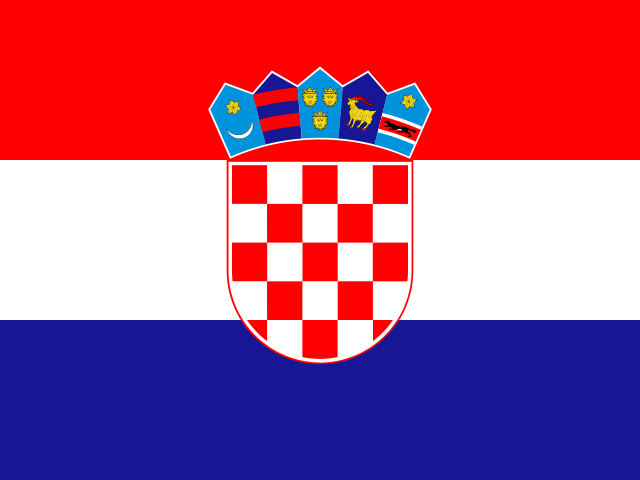
Is my language worth passing on?
Snjezana Markus
4 min read


How many times have you heard:
But Croatian isn’t really that useful.
It’s better to put their focus on English.
You don’t want to confuse them.
But it is such a difficult language to learn. Why would you bother your child?
Many parents who are raising multilingual children hear some version of this at some stage.
Sometimes from relatives.
Sometimes from friends.
Sometimes from random people they encounter daily.
Sometimes even from professionals.
And slowly, doubt creeps in. 😟
Is my language important enough?
Am I confusing my child?
Will my child pick up English?
Am I making things unnecessarily harder?
Let’s take a deep breath and pause.
🌍 When a language is labelled “not useful”, “not important” or “too small”
When a big company is deciding which languages to put on their website or product (like Amazon, Apple or Netflix), they have to take into account various factors that will determine the potential impact of that additional cost. This is where the “importance” of a language makes sense, as it’s usually connected to a very crude, monetary measurement of return on investment.
However, when it comes to families, there is no “big” or “small” language. For many families, their home language, be it Croatian, Portuguese, Polish, Romanian, Hungarian or any other language, can feel small in comparison to the language of the community, especially if parents do not get enough support or they fall victim to random comments on why they should or shouldn’t keep any language. The truth is that your home language may not be widely spoken in your child’s school or may not appear “economically powerful” to carry what you feel is “enough weight”.
But usefulness should not be measured by the global status of a language. Language should be considered “useful” (for lack of a better word) when it allows your child to:
Speak to their grandparents and the rest of the extended family.
Understand family history.
Feel connected when visiting relatives and your home country.
Express emotions with parents in their native language.
For families, this is not a small thing.
THIS IS BIG.


⚠️ When you are advised to drop a language
Some parents are advised to focus only on one language, especially in situations when:
A child “shows” speech delay.
A child starts mixing languages.
Parents are worried whether their child will pick up the community language (e.g. English) at the same pace as their monolingual peers.
It’s very important to emphasise that research consistently shows that multilingualism does not cause language delay. If there is any speech difficulty or impediment, it’s usually manifested in all languages used. If a child has a speech or language development difficulty, the presence of a second language doesn’t make it worse. Removing one language to make things “easier” is a bit like stopping a child from learning maths because they find reading difficult: the two challenges are not caused by each other. Therefore, dropping a language does not “solve” the underlying speech challenges.
On the contrary, in many cases, maintaining an additional language IS recommended, even if speech support is needed, because the emotional bond and support between a parent and a child should be maintained to facilitate difficult moments they might experience.
As a conclusion, if any concern exists, the right approach is informed guidance, not language elimination.
🧠 The brain does not “rank” languages


It goes without saying that the brain does not evaluate languages by their economic power or global influence.
From a linguistic, developmental and cognitive perspective:
English + Croatian
English + Polish
English + Spanish
English + Hungarian
All create a bilingual brain.
Therefore, the cognitive benefits linked to multilingualism, such as flexibility, adaptability and metalinguistic awareness (just to name a few) are not reserved for “big” languages. They apply to all languages.
Why parents often give up 💭
Parents rarely abandon their home language because they do not care. They usually stop because they feel alone and isolated. They are not informed and are often actually misinformed about the effects that multilingualism may have on their child’s language development or school performance.
Over time, community language becomes easier and slowly the minority language fades away.
That does not happen because the language was worthless, but because parents lack information, structure and support.
❤️ Worth is not about global status or the number of speakers
Don’t consider your language less valuable just because it feels small or not “worth enough”.
Don’t ask yourself, “Is this language globally powerful?”
Instead, always ask, “Is this language important to me?”
Remember, when you talk to your child in your mother tongue, you are passing on your whole story and giving them access to a fuller version of yourself.
And that is what matters.
So… Is it worth it?
Let’s return to the original question: Is your home language worth passing on?
If it carries your story.
If it is part of who you are.
If it connects your child to family.
If it gives them cultural depth.
If it strengthens cognitive development.
Why wouldn’t it be? ✨
If you are unsure how to maintain your home language in a different language-speaking environment, you don’t need to navigate it alone.
👉 Book a 1:1 Consultation
👉 Explore a Family Language Plan
👉 Or simply contact me
Your language is not too small.
And remember, nobody ever regrets learning their family’s language.
Contact
Newsletter
© 2026. All rights reserved.
MULTILINGUAL MARVELS
... because multilingualism is a lifelong gift.